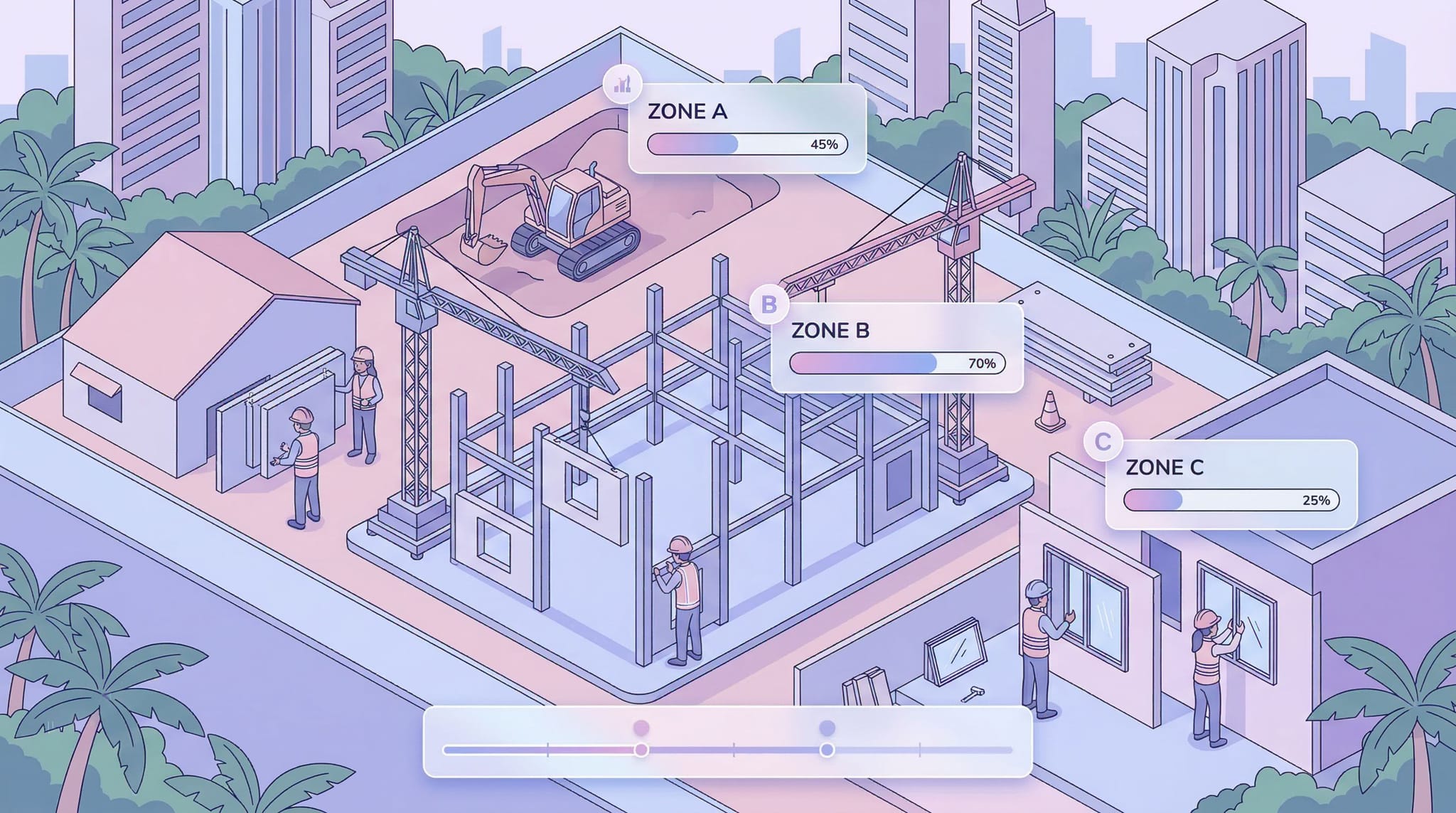
The Percentage Completion Game
Ask any experienced construction project manager about progress tracking and they'll tell you the same thing: the numbers lie.
Not maliciously — but structurally. Progress percentages on construction projects are typically self-reported by the people doing the work. A subcontractor says their trade is "80% complete." The site manager records it. The monthly report shows 80%. The client sees 80%.
But what does 80% actually mean? Is it 80% of the area covered? 80% of the hours spent? 80% of the activities ticked off a checklist? Different people use different definitions, and the number rarely corresponds to physical reality until someone walks the site and compares what they see against what was reported.
According to KPMG's Global Construction Survey, only 31% of construction projects come within 10% of their original deadlines. The rest overrun — and a significant contributing factor is that progress data is inaccurate, delayed, or both. Decision makers are steering based on stale information.
This is the problem AI agents in construction are best positioned to solve — not by adding another reporting layer, but by connecting progress claims to photographic evidence automatically.
What Photo-Based Progress Tracking Actually Looks Like
The concept is simple: workers are already photographing their work throughout the day. They do this for their own records, for coordination with other trades, and because supervisors ask for updates. These photos flow through WhatsApp groups, mostly as proof of work completed.
An AI agent intercepts these photos and extracts progress information from them. Here's a concrete example:
A foreman sends a photo of a completed slab with the message: "Block A L3 slab poured, curing started."
The AI agent processes this into a structured record:
- Zone: Block A, Level 3
- Activity: Slab casting — completed
- Next activity: Curing (implied start)
- Evidence: Photo attached, timestamped, geotagged
- Schedule comparison: Planned completion was yesterday — 1 day behind baseline
That last point is where it gets useful. The agent doesn't just record what happened — it compares it against what should have happened according to the project schedule. If the planned date for this slab was yesterday, the system immediately flags a 1-day variance.
Why the Schedule Comparison Matters More Than the Photo
Photo evidence of progress is valuable, but the real impact comes from the automated schedule comparison. Without it, you have a photo library. With it, you have an early warning system.
Consider the difference in response time:
Traditional flow: Slab is poured on Tuesday. Foreman mentions it in the weekly coordination meeting on Thursday. PM updates the programme on Friday. Variance report reaches the client on Monday. Total delay to awareness: 6 days.
AI agent flow: Slab is poured on Tuesday. Photo is sent at 3pm. AI logs completion and flags 1-day variance at 3:01pm. PM receives alert. Total delay to awareness: 1 minute.
On a project where a 1-day delay in structural work cascades into 3-5 days of downstream trade delays, that 6-day difference in awareness can be the difference between a minor schedule adjustment and a recovery programme that costs six figures.
The Daily Log Problem
Progress tracking isn't just about milestone completion. It's about the daily log — the record of what happened on site each day. Who was there. What work was done. What materials were used. What issues arose.
On most sites, the daily log is produced by a site manager who spends 45 minutes to an hour at the end of each day reconstructing events from memory, notes, and WhatsApp scrollback. It's one of the most time-consuming and least valuable administrative tasks in construction — because by the time the log is written, the day is over and the information is too late to act on.
AI agents compile the daily log automatically from the messages and photos that flow through project WhatsApp groups throughout the day. Each message is parsed, classified, and logged in real time. By 5pm, the daily log already exists — structured, timestamped, and linked to photographic evidence. The site manager reviews and approves it instead of writing it from scratch.
The time saving is significant, but the quality improvement matters more. A log compiled in real time from primary sources is more accurate than one reconstructed from memory hours later. And when a dispute arises about what happened on a particular day — which it will, because construction disputes always come down to documentation — the AI-compiled log has photos and timestamps that a handwritten log doesn't.
The Earned Value Problem
For projects that use earned value management (EVM) or similar performance measurement methods, the quality of progress data directly affects financial reporting. If a contractor claims 80% completion and bills accordingly, but physical progress is actually 65%, the project has a 15% over-certification problem that will surface eventually — usually at the worst possible time.
Photo-based progress tracking provides an independent data source for verifying earned value claims. When every completion claim is linked to a timestamped photo of the actual work, the conversation between contractor, consultant, and client shifts from "what do you claim?" to "what does the evidence show?"
This doesn't eliminate disagreements — reasonable people can disagree about what constitutes "complete" — but it moves the disagreement from memory and assertion to evidence and documentation. That's a qualitative improvement in how progress disputes are resolved.
What This System Needs to Work
The requirements are deliberately minimal:
- WhatsApp groups for each project — which already exist on virtually every site
- A baseline schedule — the project programme that defines planned completion dates for each activity and zone
- Zone and activity naming conventions — so the AI can map messages to the right part of the project. This is usually established during the first week of deployment through a brief calibration process
There's no hardware to install. No sensors. No cameras to mount. The "sensors" are the smartphones workers already carry, and the "data pipeline" is the WhatsApp group they already post to.
What It Doesn't Replace
AI-powered progress tracking doesn't replace the project manager's judgment about schedule recovery. It doesn't replace the QS's assessment of earned value. It doesn't replace the consultant's professional opinion on completion percentages for payment certification.
What it does is give all of these people better data, faster. The PM sees variances in real time instead of next week. The QS has photo evidence linked to every completion claim. The consultant can review timestamped progress against the programme without waiting for the monthly report.
Better data, sooner, with less manual effort. That's what this is.
Talk to us about deploying AI-powered progress tracking on your project, or see how other teams are using this approach in our case studies.
Part of our series on AI in construction. See also: What Is Agentic AI in Construction? and Construction Safety with AI.