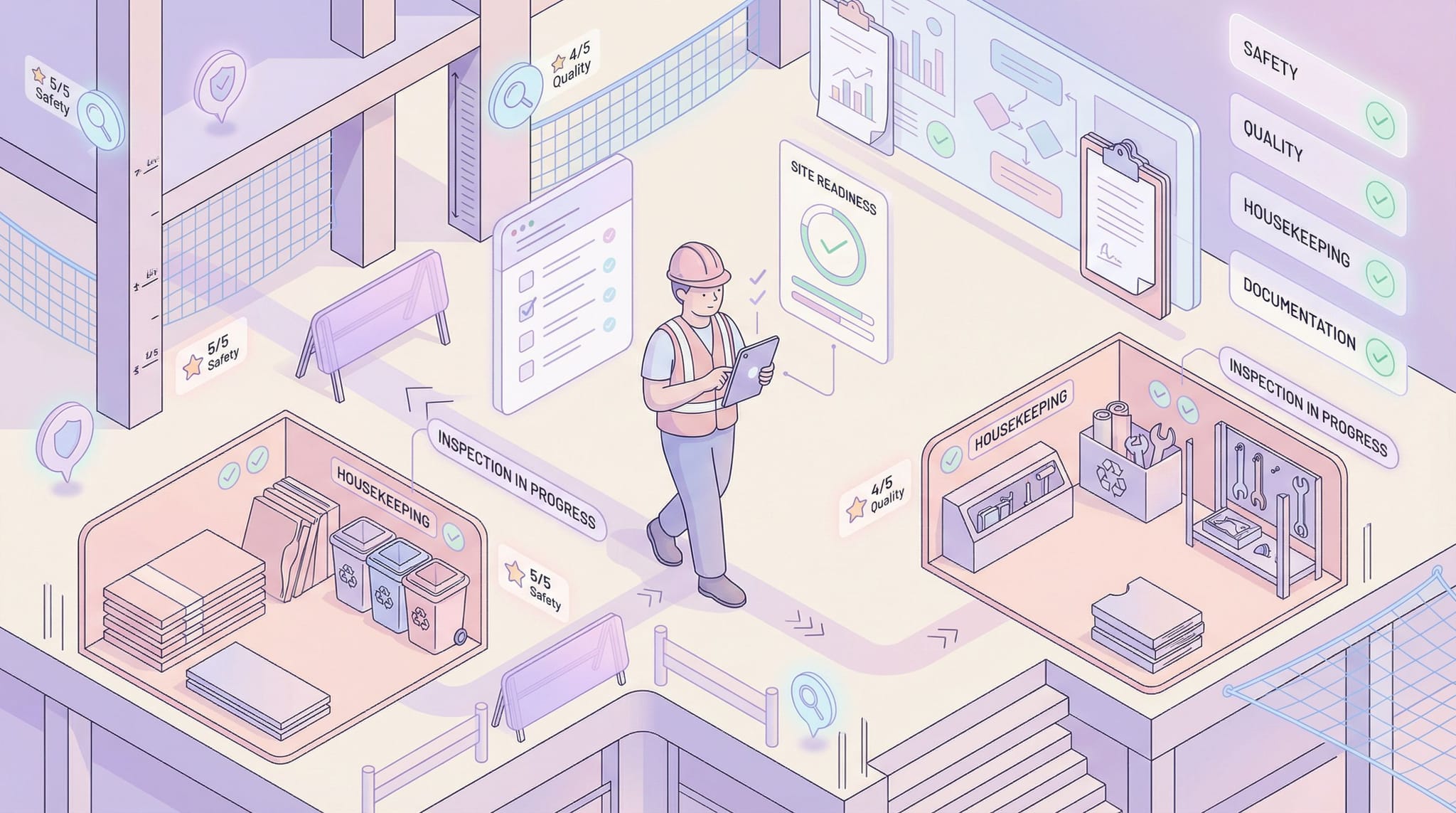
Why Site Readiness Matters
Many site issues do not start as major incidents. They start as small signs that a project is slipping out of control: blocked access routes, outdated drawings, poor housekeeping, missing inspection records, repeated defects, or hazards that are noticed but not closed out.
A construction site readiness checklist gives contractors a practical way to review those signals before they become delays, claims, rework, or safety events. Instead of relying on gut feel alone, site teams can use a consistent scoring method to evaluate whether a project is actually ready to operate safely, efficiently, and in line with client expectations.
This matters for more than compliance. A well-run site is usually easier to supervise, easier to coordinate, and easier to keep on schedule. When site readiness is weak, the same issues tend to show up across safety, quality, and documentation at the same time.
What a Construction Site Readiness Checklist Should Measure
A useful checklist should not try to capture every possible detail on site. It should focus on the core areas that reveal whether the project is under control.
For most contractors, that means scoring five categories:
- Safety controls
- Housekeeping and access
- Quality readiness
- Documentation and compliance
- Action tracking and coordination
The goal is not to create another form that gets filed away. The goal is to create a repeatable site review that supervisors, project managers, and leadership can actually use.
1. Safety Controls
The first section of any site readiness checklist should review basic safety conditions. This includes PPE use, work-at-height controls, edge protection, ladder condition, scaffold condition, plant movement controls, and whether high-risk activities are properly briefed before work starts.
A site can look busy and productive while still being poorly controlled. For that reason, readiness scoring should go beyond whether a rule exists on paper. It should ask whether the control is visible on site and being followed consistently.
Questions to include:
- Are workers using task-appropriate PPE correctly?
- Are high-risk work areas identified and protected?
- Are ladders, scaffolds, and temporary access points in safe condition?
- Are lifting zones and plant routes controlled?
- Are hazards communicated clearly before work begins?
If supervisors regularly find the same safety issues during routine walks, that is usually a sign that the site is operating reactively instead of systematically.
2. Housekeeping and Access
Housekeeping is often underestimated, but it is one of the fastest ways to judge whether a project is under control. Poor storage, blocked walkways, unsecured materials, and unmanaged waste all increase risk and reduce productivity.
Good housekeeping is not only about tidiness. It affects how quickly teams can move, how safely plant can operate, and how easily workers can access the right work areas without creating secondary hazards.
Questions to include:
- Are walkways, stair routes, and access points clear?
- Are materials stored in designated areas?
- Is waste removed frequently and safely?
- Are tools and equipment returned to the right locations?
- Are delivery and staging areas controlled?
If access is poor, crews lose time. If storage is poor, damage and defects become more likely. If housekeeping is poor, safety performance usually suffers as well.
3. Quality Readiness
Many construction teams separate quality from site readiness, but that is a mistake. A site is not truly ready if teams are working from outdated drawings, unclear method statements, or incomplete handover conditions between trades.
Quality readiness should measure whether work can be executed correctly the first time. That includes access to current information, clear inspection points, and a process for identifying and resolving defects before they multiply.
Questions to include:
- Are the latest drawings and specifications available on site?
- Do supervisors know the required inspection points for current works?
- Are completed works checked before the next trade starts?
- Are defects recorded clearly with enough detail to act on?
- Are recurring quality issues reviewed and addressed?
A strong quality section helps reduce rework, protects programme, and improves client confidence during inspections and handovers.
4. Documentation and Compliance
A site may appear organized but still be weak on records. Missing permits, incomplete induction logs, outdated inspection forms, and inconsistent sign-offs create problems when incidents occur or when clients request evidence.
Documentation and compliance should therefore be scored as part of day-to-day readiness, not treated as a separate office exercise.
Questions to include:
- Are required permits current and accessible?
- Are induction and briefing records complete?
- Are inspection forms up to date?
- Can the team quickly produce the latest supporting documents if asked?
- Are site observations and corrective actions recorded in a consistent format?
This section is especially important for contractors managing multiple projects. If every site keeps records differently, leadership has very little visibility into what is really happening on the ground.
5. Action Tracking and Coordination
Most sites do not fail because they never notice problems. They fail because the same problems are noticed repeatedly without being closed out properly.
That is why action tracking deserves its own readiness category. If an issue is raised, the checklist should make it clear who owns it, when it must be fixed, and whether it has actually been closed.
Questions to include:
- Are issues assigned to a named person?
- Are target dates for corrective action clear?
- Are overdue items visible to supervisors and management?
- Are repeated issues escalated when they continue to appear?
- Is there a reliable follow-up process after inspections or walks?
This is often the difference between a checklist that creates work and a checklist that improves performance.
A Simple Site Readiness Scoring Model
The checklist becomes more useful when each category is scored consistently. A simple 1 to 5 scale is usually enough.
| Score | Meaning | Practical interpretation |
|---|---|---|
| 1 | Poor control | Serious gaps, frequent issues, little evidence of follow-through |
| 2 | Weak control | Some controls exist, but execution is inconsistent |
| 3 | Basic control | Minimum expectations met, but improvement is needed |
| 4 | Strong control | Conditions are well managed with only minor gaps |
| 5 | Excellent control | Controls are consistent, visible, and actively maintained |
After scoring each category, calculate an overall site readiness score. That overall score should not replace the detail, but it helps leaders compare trends across projects and identify where management attention is needed.
A practical interpretation model might look like this:
- 4.5 to 5.0: High readiness
- 3.5 to 4.4: Generally controlled, with some improvement areas
- 2.5 to 3.4: Inconsistent execution and elevated risk
- Below 2.5: Reactive site management and urgent corrective action required
How Often Should Contractors Use a Site Readiness Checklist?
The best frequency depends on the stage and complexity of the project, but a few rhythms work well:
- Daily for active high-risk areas
- Weekly for formal readiness scoring
- Before major work phases begin
- Before client inspections, internal audits, or handovers
Short, regular reviews are usually more effective than long monthly forms. The checklist should support how the site already operates, not slow it down.
Common Mistakes to Avoid
Some site readiness checklists fail because they are too broad. Others fail because they are too vague. The most common mistakes are:
- Scoring without clear evidence from the field
- Treating checklist completion as the goal
- Using inconsistent scoring standards between projects
- Recording issues without assigning ownership
- Collecting photos and notes that are difficult to retrieve later
If teams cannot explain why a site scored a three instead of a four, the scoring model is probably too subjective.
What Strong Contractors Do Differently
The best-performing contractors usually do a few things well. They keep the checklist simple. They review the same categories repeatedly. They make ownership clear. They follow through on actions. And they use the findings to coach teams, not just to report upward.
Over time, that creates a better operating rhythm. Site teams know what good looks like. Managers can compare projects more fairly. Leadership gets a clearer picture of where support is needed before small issues become expensive ones.
From Checklist to Better Site Control
A construction site readiness checklist is most valuable when it leads to action. If the checklist lives on paper, in disconnected chat threads, or across multiple spreadsheets, it becomes harder to track trends and close issues consistently.
That is where a more structured workflow can help. Many contractors start with a simple checklist, then move toward a system that makes it easier to capture site observations, assign actions, and keep records organized across projects.
At Wenti Labs, we work with construction teams that want better visibility into site issues without adding more admin overhead. If your team is reviewing safety, quality, and compliance manually today, the next step may be a workflow that helps you run the same process with more consistency and less friction. You can see how teams approach this in our case studies.
Final Thoughts
Site readiness is not a one-time exercise. It is a way to measure whether a project is prepared to operate safely, deliver quality work, and stay in control as conditions change.
For contractors that want fewer surprises on site, a clear readiness checklist is one of the simplest places to start. It gives teams a shared standard, helps management focus attention where it matters, and creates a stronger foundation for safety, quality, and compliance across every project.
FAQ
What is a construction site readiness checklist?
A construction site readiness checklist is a structured review used to assess whether a site is prepared to operate safely, efficiently, and in compliance with project requirements. It usually covers safety, housekeeping, quality, documentation, and action tracking.
Who should complete a site readiness checklist?
It is usually completed by site supervisors, safety personnel, project managers, or other team members responsible for site coordination. Some contractors also use it during leadership walkdowns or internal audits.
How is a site readiness checklist different from a safety checklist?
A safety checklist focuses mainly on hazards and controls. A site readiness checklist is broader. It also looks at housekeeping, quality readiness, documentation, and whether issues are being followed through to closure.
How can contractors use readiness scores across projects?
Readiness scores help contractors compare site conditions across multiple projects, identify repeated weaknesses, and direct support to the sites that need it most. The score is most useful when the same categories and scoring standards are applied consistently.