Construction Runs on WhatsApp. That's the Starting Point, Not the Problem.
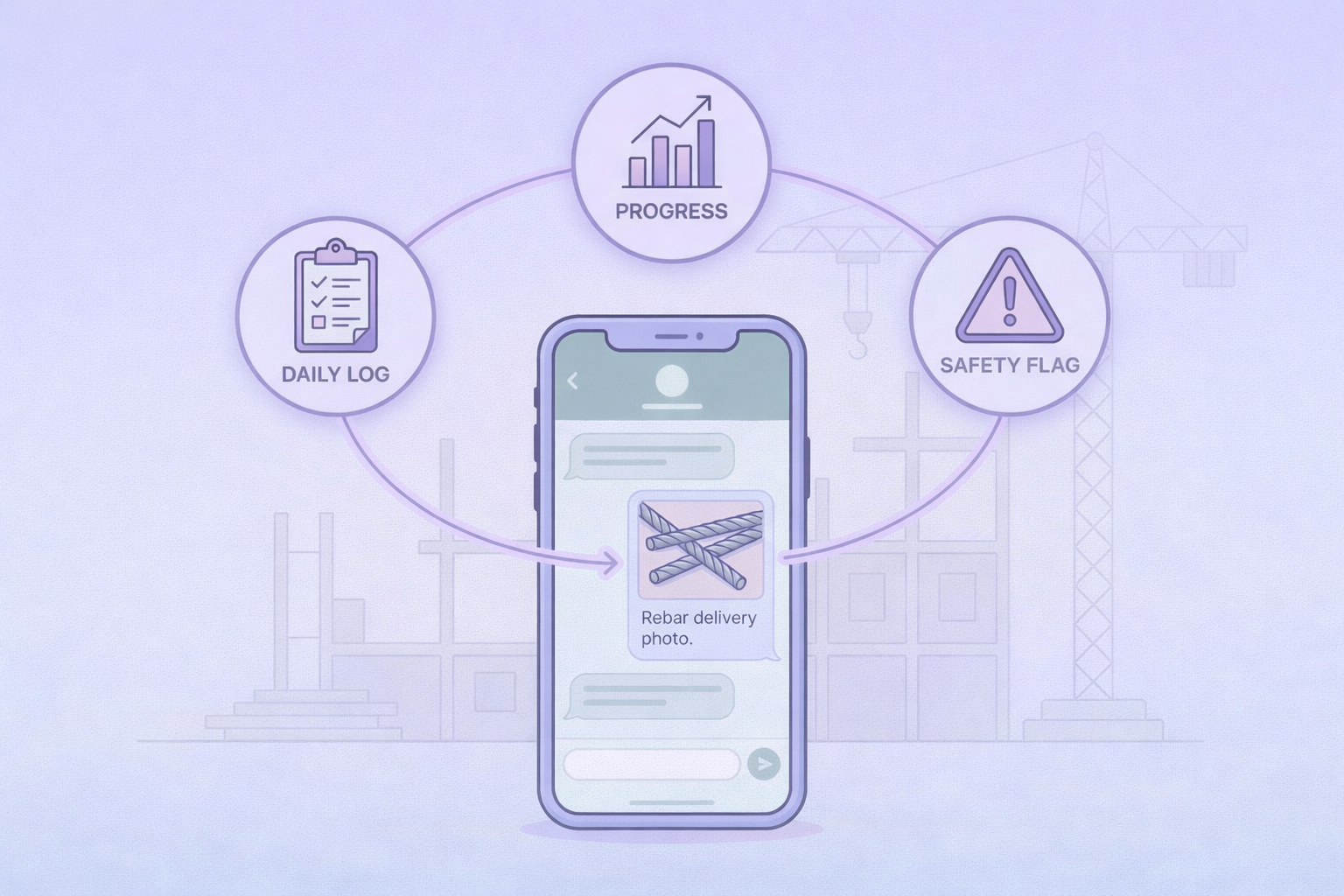
Across Southeast Asia and much of the world, WhatsApp is how construction gets coordinated. Foremen send progress photos. Subcontractors confirm material deliveries. Site managers relay instructions. Safety officers flag issues. It's fast, it's free, and — critically — everyone already knows how to use it.
The standard technology industry response to this reality is to try to replace WhatsApp with a purpose-built platform. BIM collaboration tools, project management apps, digital inspection systems — construction has no shortage of software that promises to bring order to the chaos. The problem is adoption. According to McKinsey, construction remains one of the least digitised industries in the world, and the pattern is consistent: companies buy licenses, run training sessions, and six months later the field teams are back on WhatsApp.
The insight behind AI agents on WhatsApp isn't that WhatsApp is the best possible tool for construction management. It's that the tool people actually use is more valuable than the tool they're supposed to use. The data is already flowing through WhatsApp. The question is whether you can extract structured, auditable information from it without asking anyone to change their behaviour.
What an AI Agent Actually Does to a WhatsApp Message
Here's a concrete example. A foreman sends this message to a project group chat at 3:47pm:
"Block B L5 slab casting done. Rebar inspection passed this morning. Tomorrow starting formwork L6. 2 workers absent today, short on labour for next week."
A human reading this understands it. But the information is locked inside a chat thread — unsearchable, unstructured, and disconnected from any project management system. An AI agent parses this single message into multiple structured records:
| Field | Extracted Value |
|---|---|
| Zone | Block B, Level 5 |
| Activity completed | Slab casting |
| Inspection status | Rebar inspection passed |
| Planned activity (tomorrow) | Formwork, Level 6 |
| Manpower issue | 2 absent, shortage flagged for next week |
| Timestamp | 2025-12-08 15:47 SGT |
This extraction happens automatically. The foreman doesn't fill in a form. They don't tag fields. They don't even know the AI is processing their message. The structured data flows into the project's daily log, the progress tracker, and the manpower dashboard — all from a single chat message.
Photos Are Where the Real Value Is
Text messages carry useful information, but photos are where construction AI agents create the most value. A site photo contains far more structured data than the caption that accompanies it.
When a worker sends a photo of completed rebar work with the caption "Zone C rebar done", the AI agent processes both. The text gives zone and activity. The photo gives:
- Visual verification that the described work matches what's shown
- Quality indicators — rebar spacing, cover blocks visible, tie wire condition
- Safety compliance — PPE visibility, edge protection, housekeeping
- Progress evidence — a timestamped, geotagged photo linked to a specific activity and zone
A single photo sent via WhatsApp can generate a progress update, a quality record, and a safety observation simultaneously — data that would normally require three separate inspection forms.
What Doesn't Work Yet
Honesty about limitations matters. There are things AI agents on WhatsApp handle well, and things they struggle with:
Voice notes are common on construction sites, especially among workers who find typing slow. Current speech-to-text models work reasonably well for clear English or Mandarin, but construction sites are noisy and multilingual. A voice note mixing Mandarin, Malay, and Hokkien with heavy machinery in the background is hard for current models to transcribe accurately. We process voice notes but flag low-confidence transcriptions for human review rather than treating them as ground truth.
Abbreviations and shorthand vary by team. "RFI" is standard. "Lvl 3 RC done tmr start fw" requires context about the specific project's terminology. The AI agent needs exposure to a project's communication patterns before it reliably parses team-specific shorthand — typically a few days of calibration after initial deployment.
Group chat noise is real. Not every message in a project group is work-relevant. Lunch plans, jokes, scheduling discussions — the agent needs to distinguish between operational data and social communication. This works well for clear operational messages and poorly for ambiguous ones. We err on the side of ignoring uncertain messages rather than generating false records.
The Architecture: What Sits Between WhatsApp and Your Systems
The AI agent operates as a processing layer between WhatsApp (where data enters) and the project's data systems (where structured records live). The flow:
- Message received via WhatsApp Business API — text, photo, video, or voice note
- Classification — is this operational content or noise? What category (progress, safety, quality, logistics)?
- Extraction — structured fields pulled from text; computer vision applied to images
- Validation — cross-reference against project data (zone names, activity schedules, expected work)
- Routing — structured records pushed to the appropriate system: daily log, defect register, safety record, progress tracker
- Alerting — if the message contains something that requires action (safety issue, schedule risk, quality defect), the relevant person is notified
The agent also handles the reverse direction. When a supervisor needs a status update, they can message the agent directly: "What's the status of Block A Level 3?" The agent queries the structured records and responds with a summary — again, inside WhatsApp.
Why This Matters for Construction Specifically
Other industries have solved data capture through enterprise software because their workers sit at desks with computers. Construction can't do this. The people generating the most valuable operational data — foremen, supervisors, trade workers — are on sites with limited connectivity, dirty hands, and no time for form-filling.
Every previous generation of construction technology asked these people to change their behaviour. AI agents on WhatsApp are the first approach that doesn't. The data capture happens as a byproduct of communication that's already occurring. That's not a minor UX improvement — it's a fundamentally different adoption model.
Talk to us about deploying WhatsApp AI agents on your project, or see how other teams are using this approach in our case studies.
Part of our series on AI in construction. See also: What Is Agentic AI in Construction? and Construction Safety with AI.